
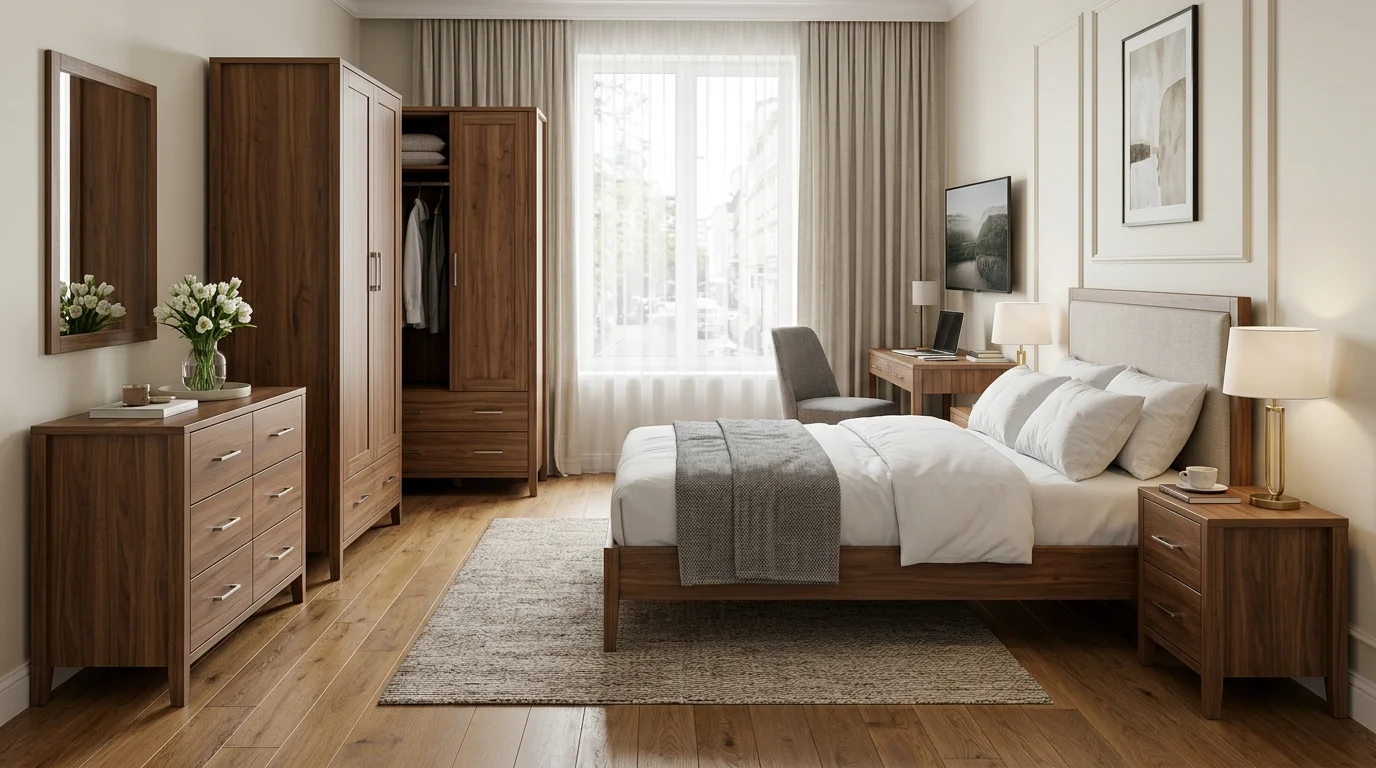
Introduction
Selecting hotel room furniture sets is a budgeting decision, a brand decision, and an operational one at the same time. The right mix of casegoods, seating, and finishes can reinforce a luxury experience or help a budget property deliver durability, consistency, and value without overspending. This article explains how to match furniture choices to hotel positioning, ownership goals, guest expectations, and renovation cycles, so purchasing decisions support both daily performance and long-term return on investment.
Align Hotel Room Furniture with Positioning
Hotel room furniture sets represent a critical capital expenditure in hospitality asset management, typically accounting for 10% to 15% of total property development or renovation costs. Strategic procurement of Furniture, Fixtures, and Equipment (FF&E) requires aligning casegoods and soft seating with the overall asset strategy, ensuring that the physical environment accurately reflects the target market.
How furniture sets shape brand positioning
Furniture sets act as a primary physical manifestation of a hotel’s brand identity and directly influence guest satisfaction metrics. In luxury properties, bespoke casegoods, premium veneers, and ergonomic seating validate high Average Daily Rates (ADR) and support a premium positioning. Conversely, budget and economy segments rely on highly durable, standardized sets that communicate cleanliness and operational efficiency without inflating capital expenditures. The distinction lies in the sensory feedback of the materials and the spatial harmony achieved within the guestroom footprint.
How ownership model and renovation cycle affect choices
The ownership model—whether driven by a Real Estate Investment Trust (REIT), an independent owner, or a franchised operator—dictates the capital expenditure strategy and return on investment (ROI) expectations. Institutional owners typically model a 5-to-7-year renovation cycle for soft goods (upholstery, window treatments) and a 10-to-14-year cycle for hard casegoods (wardrobes, desks, nightstands). Franchised properties must strictly adhere to brand-mandated Property Improvement Plans (PIPs), which enforce exact timelines and specifications for furniture replacement to maintain flag status. Understanding these cycles ensures that the durability of the selected furniture matches its intended operational lifespan.
Define Specifications and Quality Standards

Establishing rigorous technical specifications is the foundation of successful FF&E procurement. Clear documentation prevents scope creep, minimizes manufacturing defects, and ensures that the final delivered products meet the rigorous demands of a commercial hospitality environment.
Which components, materials, and construction details to specify
Commercial hospitality furniture requires robust construction techniques that far exceed residential standards. Casegoods must utilize premium Medium Density Fiberboard (MDF) or solid wood cores, avoiding low-grade particleboard that degrades under moisture. Surface finishes frequently require High-Pressure Laminate (HPL) with a minimum thickness of 0.8mm to 1.2mm for scratch and heat resistance. Joints must be double-dowelled, glued, and screwed, while drawers require heavy-duty, full-extension ball-bearing glides rated for at least 50 to 75 pounds of dynamic load.
How luxury and budget hotel furniture requirements differ
The dichotomy between luxury and budget requirements is most evident in material selection, customization, and cost parameters. Budget hotels prioritize standardization and impact resistance, utilizing melamine surfaces and exposed hardware. Luxury hotels demand complex material mixing, such as integrating brushed brass, natural stone tops, and matched wood veneers into a single credenza.
| Specification Area | Budget / Economy Segment | Luxury / Upscale Segment |
|---|---|---|
| Estimated Cost per Key | $2,500 – $4,500 | $15,000 – $35,000+ |
| Core Materials | Melamine, standard MDF, laminate | Solid hardwoods, premium veneers, stone |
| Hardware & Glides | Standard commercial-grade | Soft-close, concealed, custom cast |
| Customization Level | Off-the-shelf, catalog standard | 100% bespoke, architect-designed |
How to compare quality and lifecycle cost
Procurement teams must evaluate furniture not merely on its initial Free on Board (FOB) price, but on its Total Cost of Ownership (TCO) over a 10-year lifecycle. A nightstand priced 20% lower upfront may utilize inferior edge-banding that delaminates within three years of heavy housekeeping use, necessitating premature replacement. Comparing quality requires analyzing warranty terms, the availability of replacement parts, and the ease of on-site maintenance, such as whether upholstery covers are removable and washable or if casegood tops can be easily refinished.
Compare Sourcing and Supplier Options
Navigating the global supply chain requires procurement managers to evaluate varying manufacturing capabilities. By analyzing global trade flows via resources like TradeMap, buyers can identify regional hubs that specialize in specific hospitality manufacturing disciplines, balancing cost against logistical complexity.
When to choose custom, semi-custom, or standard furniture
The decision between standard, semi-custom, and custom furniture is driven by the project’s scale, budget, and brand standards. Standard, catalog-based furniture is ideal for budget properties or rapid renovations, often requiring low Minimum Order Quantities (MOQs) of 10 to 50 keys. Semi-custom options allow buyers to alter finishes or dimensions on existing frames, offering a middle ground. Fully custom furniture, essential for luxury and boutique hotels, typically requires an MOQ of 50 to 100+ keys to absorb the high engineering and tooling costs associated with bespoke production.
How to assess manufacturers and sample approval
Evaluating a manufacturer requires rigorous due diligence, including factory audits to assess production capacity, quality control frameworks, and financial stability. The sample approval process, often culminating in a fully installed “model room,” is a critical milestone. Producing these initial prototypes typically takes 30 to 45 days. Stakeholders review the model room for ergonomic flow, finish accuracy, and structural integrity, ensuring any modifications are engineered into the technical drawings prior to mass production.
Which cost drivers affect landed price
The landed price of hotel furniture is influenced by a complex matrix of cost drivers extending far beyond raw materials and factory labor. Ocean freight, import duties, and currency fluctuations can add 15% to 30% to the factory-gate price. For example, a standard 40-foot High Cube (40HC) container typically holds 15 to 20 keys worth of casegoods; fluctuations in container shipping rates directly impact the per-key cost. Buyers must negotiate clear Incoterms—such as Delivered Duty Paid (DDP) versus FOB—to accurately model the final landed cost.
Plan Compliance, Logistics, and Installation
Executing a hotel furniture rollout requires meticulous alignment with international safety regulations and synchronized logistics. Failure to manage compliance and freight can result in stalled occupancy permits or damaged inventory.
Which fire safety, accessibility, and VOC standards matter
Hospitality environments are strictly regulated to ensure life safety and indoor air quality. Upholstered furniture must meet stringent flammability standards, such as California Technical Bulletin 117-2013 (CAL 117) or rigorous ISO fire test protocols. Accessibility is equally critical; in the United States, ADA compliance mandates specific clearances, such as desks requiring a minimum 27-inch knee clearance. Furthermore, Volatile Organic Compound (VOC) emissions from adhesives and particleboard must comply with standards like CARB Phase 2 to prevent off-gassing and ensure a healthy environment for guests.
How lead times, freight, warehousing, and installation affect projects
Logistical planning dictates the success of the installation phase. Standard production lead times span 8 to 12 weeks, followed by 4 to 6 weeks of ocean transit and customs clearance, culminating in a total lead time of 16 to 24 weeks.
| Project Phase | Estimated Duration | Key Deliverables & Risk Factors |
|---|---|---|
| Prototyping / Model Room | 4 – 6 Weeks | Design sign-off, ergonomic testing |
| Mass Production | 8 – 12 Weeks | Quality control inspections, packaging |
| Freight & Customs | 4 – 6 Weeks | Container loading, port delays, tariff clearance |
| Warehousing & Installation | 2 – 4 Weeks | Staging, debris removal, punch-list resolution |
Because construction delays frequently misalign with furniture delivery, securing local third-party logistics (3PL) warehousing is often necessary to stage inventory. Installation requires specialized FF&E contractors who can efficiently uncrate, assemble, and place items according to the approved room matrix while managing substantial packaging waste.
Finalize Selection and Procurement
The final procurement phase transitions from evaluation to binding contractual execution. Establishing a structured bidding and selection process ensures transparency, mitigates financial risk, and guarantees that the chosen supplier can execute the project parameters.
What procurement process supports a smooth decision
A smooth procurement process relies on a comprehensive Request for Proposal (RFP) that includes detailed technical specifications, required MOQs, and delivery schedules. Bid leveling is a critical exercise where procurement agents normalize proposals from multiple vendors to compare “apples to apples.” Contractual negotiations must define payment terms, which typically require a 30% to 50% deposit to initiate production, with the remaining balance tied to successful factory inspection reports prior to shipment. Establishing clear liquidated damages clauses protects the hotel developer against revenue lost due to delayed openings.
How to use a weighted scorecard to select furniture sets
To remove subjective bias from the final decision, asset managers and procurement teams should employ a weighted scorecard. This analytical tool assigns specific percentages to critical success factors based on the project’s unique priorities. For instance, a standard scorecard might allocate 35% to Total Landed Cost, 25% to Quality and Material Compliance, 20% to Production Lead Time, and 20% to Supplier Track Record and Warranty Terms. By scoring shortlisted manufacturers against these quantitative metrics, hotel operators can confidently award the contract to the supplier offering the highest holistic value.
Key Takeaways
- The most important conclusions and rationale for Hotel Room Furniture Sets
- Specs, compliance, and risk checks worth validating before you commit
- Practical next steps and caveats readers can apply immediately
Frequently Asked Questions
What furniture set works best for a budget hotel?
Choose standardized, durable sets with laminate or melamine surfaces, commercial MDF cores, and easy-to-replace parts. Focus on low maintenance and consistent room layouts.
How should luxury hotels choose room furniture sets?
Prioritize bespoke or semi-custom sets with premium veneers, stone accents, soft-close hardware, and ergonomic seating. Materials should reinforce brand identity and support higher ADR.
Which technical specs matter most when comparing hotel room furniture sets?
Check core material quality, HPL thickness, joint construction, drawer glide load rating, edge-banding durability, and finish resistance to moisture, scratches, and heat.
Should I compare hotel furniture by price alone?
No. Compare total cost of ownership, including lifespan, warranty, replacement parts, maintenance needs, and how well the set holds up over a 10-year use cycle.
When should a hotel choose custom instead of standard furniture sets?
Choose custom when brand standards, room layouts, or luxury positioning require unique dimensions and finishes. Standard sets fit budget properties needing faster procurement and lower upfront costs.


