
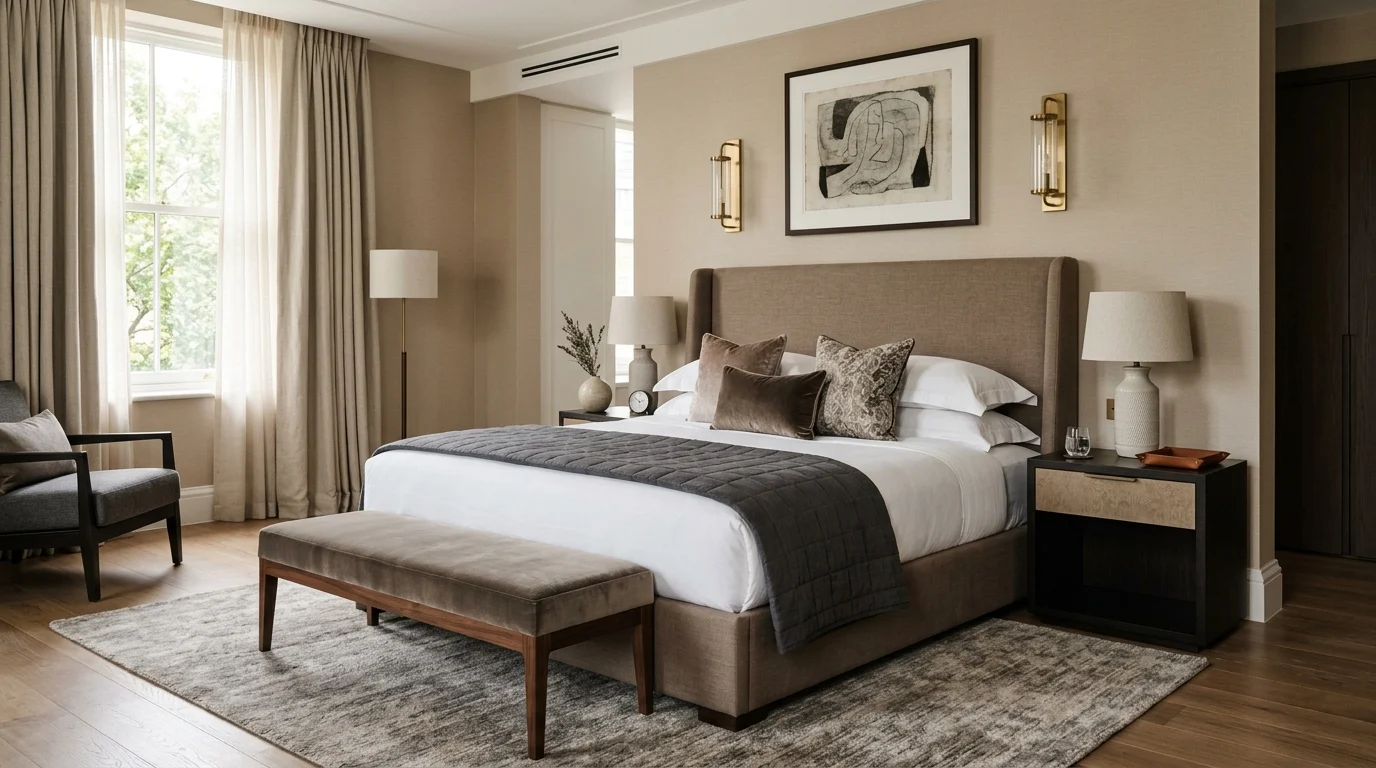
Introduction
For developers, luxury hotel bedroom furniture is more than a design finish; it is a capital decision that affects brand positioning, guest satisfaction, and long-term operating costs. The right package must support premium room rates while meeting demanding standards for durability, maintenance, and operator compliance. This guide explains how to evaluate bedroom furniture through a development lens, from aligning specifications with market segment and guest expectations to balancing upfront spend against lifecycle value. It also sets up the key factors that shape procurement choices, helping you move from aesthetic preference to investment-grade decision-making.
Why Luxury Hotel Bedroom Furniture Is a Strategic Investment
In the competitive landscape of hospitality development, Furniture, Fixtures, and Equipment (FF&E) represents a critical capital expenditure. For luxury and upper-upscale developments, FF&E typically accounts for 10% to 15% of total project development costs. Within this budget, bedroom furniture serves as the primary physical touchpoint for guests, heavily influencing their perception of value, comfort, and brand prestige.
Selecting luxury hotel bedroom furniture is not merely an interior design exercise; it is a strategic asset management decision. Developers must balance upfront capital costs with long-term durability, maintenance requirements, and the stringent standards set by global hotel operators. A well-executed furniture package enhances asset valuation, drives revenue, and mitigates the risk of premature operational disruptions.
Brand Positioning, ADR, and Guest Expectations
The relationship between room design and revenue generation is direct and measurable. Luxury hotels rely on premium tactile experiences to justify Average Daily Rate (ADR) premiums, which often target 25% to 40% above upper-upscale market competitors. Guests paying luxury rates expect residential-quality comfort combined with commercial-grade durability and flawless execution.
High-end bedroom furniture reinforces brand positioning through bespoke detailing, superior ergonomics, and acoustic dampening properties. Heavy solid wood doors on armoires, smoothly gliding nightstand drawers, and meticulously upholstered headboards collectively signal quality. When these elements align with the operator’s brand narrative, they drive positive guest reviews, increase repeat bookings, and ultimately support higher RevPAR (Revenue Per Available Room).
Risks of Under-Specifying Furniture
Value-engineering bedroom furniture to reduce initial capital outlay frequently results in disproportionate long-term costs. Under-specified furniture is prone to rapid degradation in high-traffic hospitality environments, leading to chipped veneers, failing hardware, and stained upholstery.
Standard contract furniture is typically designed for a 5-to-7-year lifecycle. In contrast, luxury hotel standards demand a 10-to-14-year lifecycle before a major soft-goods or casegoods renovation is required. Failing to meet these durability thresholds forces premature, off-cycle replacements. This not only incurs unbudgeted capital expenditures but also causes revenue displacement due to rooms being taken out of inventory for unplanned repairs.
What Defines Luxury Hotel Bedroom Furniture
Luxury hotel bedroom furniture transcends standard commercial manufacturing through its emphasis on material provenance, exacting engineering tolerances, and seamless architectural integration. Unlike mid-scale hospitality furniture, which relies heavily on high-pressure laminates (HPL) and standardized modular dimensions, the luxury tier prioritizes authentic materials and site-specific customization.
Defining this tier requires an understanding of both the visible aesthetics and the hidden structural integrity of each piece. From the density of the upholstery foam to the thickness of wood veneers, every component is engineered to withstand aggressive commercial use while maintaining a pristine, residential appearance.
Core Product Categories and Material Standards
The core bedroom suite typically encompasses the headboard, nightstands, a multifunctional wardrobe or armoire, lounge seating, and a desk or vanity. In the luxury segment, material standards for these categories are rigorously defined. For instance, while standard casegoods might use 0.3mm wood veneers or paper foils, luxury specifications generally mandate a minimum veneer thickness of 0.6mm to 0.8mm to allow for future refinishing and to resist impact damage.
Upholstered items, such as lounge chairs and headboards, require high-resiliency (HR) foam with a minimum density of 2.5 lbs per cubic foot to prevent sagging over time. Furthermore, the integration of technology is a defining characteristic of modern luxury casegoods. Nightstands and desks must feature seamlessly integrated power receptacles and USB-C charging ports, requiring internal wire management systems that do not compromise the furniture’s structural integrity or aesthetic appeal.
Bespoke vs Standard Furniture
Developers must navigate the choice between bespoke (custom-designed) furniture and standard catalog collections. Bespoke furniture offers unparalleled brand differentiation and ensures exact dimensional integration with the room’s architecture, effectively eliminating awkward gaps and maximizing usable space.
However, custom manufacturing requires significant economies of scale. Bespoke furniture programs typically demand Minimum Order Quantities (MOQs) of 50 to 100 room keys to amortize the costs of prototyping, shop drawings, and custom tooling. For boutique developments falling below this threshold, modifying high-end standard furniture with custom finishes or hardware offers a viable middle ground.
| Feature | Bespoke Furniture | Standard/Catalog Furniture |
|---|---|---|
| Lead Time | 16-24 weeks | 8-12 weeks |
| Unit Cost Premium | 20% – 40% higher | Baseline |
| Typical MOQ | 50 – 100 Keys | 1 – 10 Keys |
| Design Flexibility | Unlimited | Limited to finishes/hardware |
How to Evaluate Furniture Specifications
Evaluating furniture specifications requires rigorous technical scrutiny. Developers and their procurement agents must review detailed shop drawings, material samples, and physical model room prototypes before authorizing mass production.
A comprehensive evaluation framework assesses mechanical durability, regulatory compliance, and the lifecycle maintenance profile of the specified materials. Adherence to international standards, such as those maintained by the ISO for quality management (ISO 9001), ensures consistency across large production runs.
Construction, Finishes, Hardware, and Upholstery
The structural longevity of casegoods hinges on joinery and hardware. Luxury specifications require mortise and tenon or heavy dowel joinery at major structural intersections, with English dovetail construction for drawer boxes. Finishes must withstand rigorous cleaning protocols; catalyzed polyurethane or conversion varnish with a 30 to 40 sheen is standard for achieving both depth of color and chemical resistance.
Hardware specifications are equally critical. Drawer glides must feature ball-bearing extensions rated for a minimum dynamic load of 75 lbs to 100 lbs, incorporating soft-close mechanisms to reduce acoustic disturbance. For upholstery, fabrics must meet commercial abrasion standards, typically requiring a minimum of 50,000 double rubs on the Wyzenbeek scale, backed by moisture-barrier liners to protect the interior foam.
Fire Safety, VOC, Accessibility, and Sustainability
Compliance with safety and environmental regulations is non-negotiable. Upholstered furniture must meet regional fire safety standards, such as California Technical Bulletin 117-2013 (CAL 117-2013) or European equivalent BS 5852. Sustainability mandates are also increasingly shaping procurement, with developers requiring FSC-certified timbers and low-VOC (Volatile Organic Compound) finishes.
To maintain indoor air quality, developers should specify finishes and adhesives that achieve stringent emission thresholds, such as Greenguard Gold certification, which limits total VOC emissions to ≤ 0.22 mg/m³. Accessibility is another critical compliance vector; desks and vanities must provide precise vertical clearances (typically 27 inches minimum in the US) to comply with ADA or local equivalent accessibility guidelines.
Material Comparison Criteria
Material selection directly dictates both the aesthetic impact and the operational expenditure (OpEx) of the hotel. Natural stone tops offer premium aesthetics but require regular sealing to prevent etching, whereas sintered stone or ultra-compact surfaces provide a similar look with near-zero porosity and higher scratch resistance.
| Material Category | Typical Application | Durability Rating | Maintenance Requirement |
|---|---|---|---|
| Solid Hardwood | Edges, legs, frames | High (Impact resistant) | Medium (Periodic touch-ups) |
| Wood Veneer (0.6mm+) | Casegood faces, tops | Medium-High | Medium (Requires coasters, gentle cleaning) |
| Sintered Stone | Nightstand/Desk tops | Very High | Low (Wipe clean, no sealing) |
| PVD Coated Metal | Hardware, bases | High (Corrosion resistant) | Low (Standard dusting) |
How to Source Furniture Without Project Delays
Procurement delays are a primary cause of missed Certificate of Occupancy (CO) dates, triggering cascading financial penalties and delayed revenue generation. Successfully sourcing luxury hotel bedroom furniture requires meticulous supply chain management and proactive risk mitigation.
Developers must orchestrate a complex timeline that aligns architectural milestones with manufacturing lead times, global shipping schedules, and on-site installation availability.
Assessing Manufacturers and Factory Capacity
Selecting the right manufacturing partner is as critical as the furniture design itself. Developers must assess a factory’s financial stability, technological capabilities, and historical output capacity. A manufacturer producing luxury FF&E for a major development should demonstrate a proven production capacity of at least 500 keys per month to ensure sufficient buffer for supply chain disruptions.
Auditing the factory’s quality control (QC) processes is essential. This includes verifying in-house testing facilities for finish adhesion, hardware cycle testing, and moisture content stabilization. Factories operating in humid climates must have robust kiln-drying and climate-controlled storage to ensure wood components maintain a moisture content between 6% and 8% before shipping.
Domestic vs Offshore Sourcing
The decision between domestic and offshore sourcing hinges on a balance of unit cost, lead time, and geopolitical risk. Offshore manufacturing hubs in Southeast Asia or Eastern Europe often provide substantial unit cost savings due to lower labor rates. Tracking global trade flows through resources like TradeMap can help developers identify regions with robust furniture export infrastructures.
However, offshore sourcing introduces significant logistical lead times. Ocean freight, customs clearance, and drayage can add 4 to 8 weeks to the project timeline. Domestic sourcing dramatically reduces transit times to 1 or 2 weeks and lowers the risk of shipping damage, but it typically carries a 30% to 50% premium on unit costs. Developers often utilize a hybrid approach: offshore sourcing for bulk casegoods and domestic sourcing for custom upholstery and expedited replacements.
Logistics, Installation, and Punch Lists
The final mile of FF&E procurement involves complex logistics and installation sequencing. Deliveries must be coordinated with the general contractor’s schedule, requiring sequential loading of shipping containers so that furniture arrives exactly as floors are completed and cleared of construction dust.
Professional white-glove installation teams are required to handle heavy, high-value items, ensuring proper leveling and secure wall-mounting of headboards and armoires. To address inevitable transit damage or installation errors without delaying the hotel’s opening, developers must mandate a 2% to 3% attic stock (surplus inventory) for critical room components, allowing for immediate punch-list resolution on site.
What Buying Framework Helps Developers Choose
Establishing a formalized buying framework empowers developers to navigate the complexities of luxury FF&E procurement objectively. By standardizing the evaluation and purchasing process, development teams can align the creative vision of interior designers with the strict financial parameters of the capital budget.
A structured framework mitigates emotional decision-making, ensuring that every piece of bedroom furniture is evaluated on its total lifecycle value, compliance with brand standards, and operational functionality.
Step-by-Step Selection Process
The procurement process must follow a disciplined, chronological sequence. It begins with the conceptual design and the issuance of a detailed FF&E specification matrix. Following competitive bidding, the most critical phase is the model room development. Producing and reviewing a physical model room typically takes 12 to 16 weeks prior to mass production.
During the model room review, key stakeholders—including the developer, interior designer, hotel operator, and housekeeping staff—evaluate the furniture. This physical review allows the team to test ergonomics, verify finish durability, and identify any manufacturing flaws. Only after the model room is approved in writing, and any necessary value-engineering or design modifications are documented, should the final production deposit be released to the manufacturer.
Balancing Capex, Brand Standards, and Replacement Cycles
Ultimately, developers must evaluate furniture investments through the lens of Total Cost of Ownership (TCO). While the initial Capex for luxury bedroom FF&E can range from $15,000 to $25,000 per key, optimizing this investment requires balancing upfront costs against the anticipated replacement cycle.
Investing in superior core materials, such as solid wood edge-banding, high-resiliency foam, and premium hardware, extends the usable life of the asset. If a higher initial capital outlay delays the mandatory renovation cycle from year 7 to year 12, the annualized cost of the furniture decreases significantly. This framework ensures that the property maintains its luxury brand equity and ADR potential throughout the asset’s lifecycle, delivering maximum yield to the development’s stakeholders.
Key Takeaways
- The most important conclusions and rationale for Luxury Hotel Bedroom Furniture
- Specs, compliance, and risk checks worth validating before you commit
- Practical next steps and caveats readers can apply immediately
Frequently Asked Questions
Why is luxury hotel bedroom furniture a strategic investment for developers?
It shapes guest perception, supports ADR premiums, and reduces off-cycle replacement costs. Better specs also help protect RevPAR and long-term asset value.
What materials should developers prioritize in luxury hotel bedroom furniture?
Look for 0.6mm–0.8mm wood veneers, commercial-grade hardware, and HR foam at 2.5 lbs/ft³ or higher. These improve durability and maintain a premium appearance longer.
Should a hotel project choose bespoke or standard bedroom furniture?
Choose bespoke for strong brand differentiation and precise fit, especially at 50–100+ keys. For smaller projects, upgraded standard collections with custom finishes are often more cost-effective.
How long should luxury hotel bedroom furniture last?
A well-specified package should target a 10–14 year lifecycle. Anything closer to 5–7 years usually signals under-specification for luxury hospitality use.
What should developers confirm with a supplier before ordering?
Request shop drawings, material specs, hardware details, integrated power options, warranty terms, and lead times. On taisenfurnitureblog.com, focus on suppliers that can document both design quality and commercial durability.


