
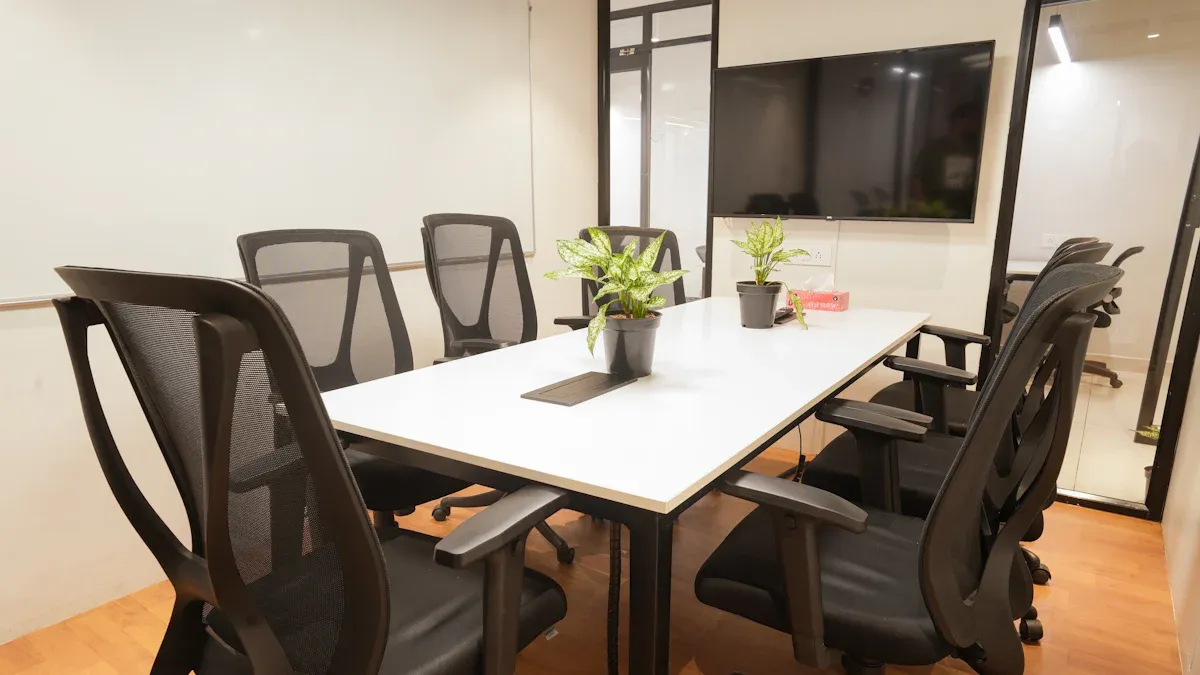
Balancing cost and quality is critical for hotel success. Hotels must navigate the complexities of hotel furniture procurement. A truly reliable hotel furniture supplier offers excellent hotel furniture solutions for large hospitality projects. A good OEM hotel furniture manufacturer, like a custom hotel furniture manufacturer, provides hotel bedroom furniture sets for boutique hotels. The best hotel furniture manufacturers in China for global projects understand these needs.
Key Takeaways
- Define your hotel’s furniture needs and budget clearly. This helps you find the right suppliers.
- Choose suppliers carefully. Look at their past work, quality control, and ability to deliver on time.
- Negotiate prices and payment terms. Also, understand warranties to protect your hotel’s investment.
Foundational Steps for Hotel Furniture Procurement
Defining Specific Furniture Needs and Style
Hoteliers must first clearly define their furniture requirements. This involves outlining the desired aesthetic, functionality, and overall guest experience. Consider the hotel’s brand identity and target demographic. For instance, a luxury boutique hotel requires different furniture than a budget-friendly establishment. Specific needs include material preferences, dimensions, and durability standards. A detailed specification guides the entire procurement process.
Conducting Comprehensive Market Research
Thorough market research is essential. This step identifies potential furniture suppliers and their product offerings. Evaluate various manufacturers, including those specializing in hotel project furniture or custom hotel furniture. Research their portfolios, client testimonials, and production capabilities. Understanding current market trends in hospitality furniture also informs selection. This research helps identify reliable partners who can meet specific project demands.
Establishing a Realistic Budget Framework
Setting a realistic budget framework is a critical initial step. This involves allocating funds for all furniture-related expenses, not just the purchase price. Consider shipping, installation, and potential customization costs. A well-defined budget prevents unexpected expenditures and ensures financial viability. It also helps narrow down supplier options to those within the established financial parameters. This framework provides a clear financial roadmap for the procurement journey.
Strategic Selection of Your Hotel Furniture Supplier

Selecting the right hotel furniture supplier is a pivotal decision for any hospitality project. This choice directly impacts the quality, durability, and aesthetic appeal of a hotel’s interiors. A strategic approach ensures a partnership that delivers value and reliability.
Key Criteria for Evaluating Potential Suppliers
Evaluating potential suppliers requires a thorough assessment of various factors. This process safeguards quality, ensures operational efficiency, and supports the hotel’s brand identity. Critical criteria encompass a proven track record and industry reputation. Manufacturers must demonstrate strong manufacturing capabilities and adhere to high factory standards. Product quality and responsible material sourcing are paramount. Suppliers must also comply with safety and industry standards. Production capacity and reliable lead times are essential for project timelines. The pricing structure should be transparent, and after-sales support with clear warranty policies is crucial. Financial stability and market reputation indicate a reliable partner. Design and innovation capabilities allow for unique and modern solutions. Logistics and delivery reliability ensure timely installation. Sustainability, including material sourcing, manufacturing processes, and product longevity, reflects a forward-thinking approach. Finally, flexibility and customization capabilities, along with a broad product range, allow for tailored solutions.
Assessing Supplier Reputation and Track Record
A supplier’s reputation and track record offer significant insights into their reliability and performance. Hoteliers should inquire about a supplier’s experience and expertise in manufacturing custom hotel furniture. They can request details on past projects and client references. Evaluating the materials used, craftsmanship, and the supplier’s quality control procedures ensures industry standards are met. Effective communication and customer service are vital for a successful partnership; therefore, assessing responsiveness, transparency, and accessibility is important. Researching their standing within the industry, reading client reviews, and seeking recommendations from professionals provides a comprehensive view. Directly contacting previous hotel clients helps gather information on adherence to deadlines, furniture quality, and issue resolution. Investigating the supplier’s industry reputation, business longevity, and track record for quality and service is also beneficial. Assessing the supplier’s financial health through references or credit checks ensures they can fulfill orders and honor warranties. Suppliers who are open about pricing, production processes, and material sourcing demonstrate transparency in operations. Prioritizing suppliers who offer clear, quick communication and responsive customer service effectively addresses questions and issues. Reviewing their portfolio of past hotel projects helps gauge experience, versatility, and the quality of their finished products, especially for similar projects. Verifying certifications like ISO, BIFMA, and fire safety ratings confirms product quality, durability, and safety compliance. Inquiring about supply chain transparency ensures fair labor practices and ethical sourcing, which positively reflects on the hotel’s brand. A reputable hotel furniture supplier consistently meets these expectations.
Verifying Manufacturing Capabilities and Quality Control
Verifying a supplier’s manufacturing capabilities and quality control processes is essential for ensuring product excellence. A reliable manufacturer employs world-advanced production lines, often with fully computer-controlled systems. They utilize advanced central dust collection systems and dust-free paint rooms, specializing in furniture design, manufacture, marketing, and one-station service for interior matched furniture. For instance, a company like TAISEN in Ningbo, China, demonstrates such capabilities, offering a wide range of products including dining sets, apartment series, MDF/PLYWOOD type furniture, solid wood furniture, hotel furniture series, and soft sofa series. They provide high-quality, one-station service for various institutions and hotels, exporting products globally.
Manufacturers should possess specific quality control certifications. These include BIFMA (for commercial and office furniture safety, durability, and sustainability), CAL 117 (fire safety), ISO 7170 (furniture stability), ANSI/BIFMA (US market standards), REACH compliance (EU regulations on chemicals), CARB certification (formaldehyde emissions), EN 12520 (European seating furniture standards), and FSC certification (sustainable wood sourcing).
Robust quality control prevents common manufacturing defects. For example, loose chair joints, often caused by weak screws or glue failure, are prevented by reinforcing with metal brackets and stronger adhesives. Scratched wooden surfaces, a result of daily wear, are minimized by using durable finishes and proper handling. Sagging cushions, typically due to low-density foam, are avoided by specifying high-density filling. Wobbly tables, caused by uneven legs or weak joints, are prevented by precise manufacturing and reinforcement. Peeling veneer, often from poor-quality laminate, is addressed by using stronger adhesives or real wood. Manufacturers implement stringent adhesion protocols and regular joint strength tests to prevent loose or weak joints. They use precision tools and alignment checks at each production stage to avoid misaligned connections. Utilizing durable fabrics and conducting rigorous tear resistance tests prevents upholstery tears. Standardized padding procedures and tactile assessments ensure even padding. Proper wood drying techniques and moisture content checks prevent warping. Sourcing high-quality wood and conducting thorough visual inspections avoid knots and voids. Investing in sturdy hardware and conducting stress tests on drawer slides and hinges ensures reliability. Finally, proper curing processes and finish adhesion tests prevent cracks in finishes, while uniform application processes and color consistency checks avoid uneven staining.
Mastering Negotiation with Hotel Furniture Suppliers
Mastering negotiation with hotel furniture suppliers is a critical skill for successful hotel projects. Effective negotiation secures the best value, ensures quality, and establishes strong, lasting partnerships. This process involves careful preparation, strategic discussions, and a clear understanding of contractual obligations.
Preparing for Competitive Bidding
Preparing for competitive bidding requires a structured approach. Hoteliers must first establish clear objectives. These objectives define pricing, quality benchmarks, and delivery timelines before any negotiation begins. This preparation helps maintain leverage throughout the process. Leveraging competitive bidding is also essential. Obtaining multiple supplier bids creates a competitive environment. This environment drives better pricing and service agreements. Building long-term partnerships is another key aspect. Negotiating with trusted suppliers fosters reliability. This reliability ensures consistency in quality and on-time deliveries.
Incorporating performance-based contracts incentivizes vendors. These agreements encourage suppliers to meet or exceed key performance indicators. Strengthening communication and transparency prevents misunderstandings. Clearly outlining expectations and maintaining open communication impacts project timelines positively. Preparing for contingencies is also vital. Hoteliers should line up alternative suppliers. This action maintains project timelines in case of delays or quality issues.
Early procurement planning minimizes risks. Locking prices ahead of time reduces market fluctuations and supply chain disruptions. This is especially true for custom-designed FF&E items. Strategic vendor negotiation leverages long-term supplier relationships. This can lead to better pricing, exclusive discounts, and favorable contract terms. Bulk purchasing and volume discounts significantly reduce per-unit costs. Consolidating orders for multiple properties or phases works well for standardized FF&E items. These items include lighting, seating, and textiles. Alternative sourcing without quality compromise identifies cost-effective material alternatives. Sourcing from global markets provides savings while maintaining design and durability standards. Optimized logistics and consolidated shipping reduce freight costs. Strategically grouping shipments maximizes efficiency in global procurement operations. Value engineering solutions assess design specifications. This finds cost-effective alternatives that retain luxury aesthetics and functionality. This enhances procurement efficiency.
Regulatory compliance is crucial. Thorough understanding and implementation of regulations ensure equal access and transparent bidding processes. A Request for Proposal (RFP) is a critical document. It outlines the scope of work, requirements, and contract terms. The RFP must be concise and comprehensive. Ethical practices demonstrate commitment to regulatory compliance. This includes risk management and financial analysis. These ensure economic efficiency and stability of bidders. Transparency in the bidding process provides clear information. This includes bidding requirements, contract terms, and evaluation criteria in the RFP. Fair treatment of all bidders ensures equal treatment. It avoids conflicts of interest and prevents discrimination during bid evaluation. Confidentiality and data protection secure bid submissions and sensitive information. Adherence to anti-corruption practices enforces strict policies. This prevents bribery, nepotism, and fraudulent practices. Regular auditing and compliance monitoring ensure adherence to established policies and legal requirements.
Adapting to market trends means continuously updating solicitation methods. This keeps them efficient and secure. Clear solicitation processes with detailed proposals ensure transparent and fair evaluation. They set exact price points and dollar thresholds. Managing emergency and discretionary purchases uses quick solicitation methods for urgent situations. This maintains competitiveness and fairness. Economic benefits of competitive bidding support fair competition. They boost the economy and encourage high standards. This leads to improved services and reduced costs. Gathering feedback from all stakeholders identifies strengths and areas for improvement. Analyzing bidding outcomes evaluates whether objectives were met. This assesses quality, fairness, and adherence to budget. Continuous improvement in bidding strategies refines approaches based on feedback and performance data. This adapts to changing market conditions. Leveraging competitive bidding as a strategic asset enhances procurement practices.
Setting clear objectives and criteria establishes SMART benchmarks. These benchmarks ensure fair and consistent evaluation. Identifying and managing key stakeholders engages internal and external parties. This considers their needs and expectations. Creating a comprehensive bid proposal articulates project requirements. It includes technical specifications, delivery timelines, and terms and conditions in a well-drafted RFP. Evaluating and selecting bids systematically reviews proposals against pre-established criteria. This includes financial stability and technical capabilities. Scoring systems ensure objectivity. Ensuring transparency and fairness maintains clear, open communication. It includes transparent disclosure of evaluation criteria and equal treatment of all bidders. Effective communication with potential bidders provides regular updates. It offers prompt answers to queries and clear guidance. This includes feedback to unsuccessful bidders.
Negotiating Favorable Pricing and Payment Terms
Negotiating favorable pricing and payment terms requires strategic planning. Hoteliers should conduct thorough market research. Understanding current market trends and pricing provides leverage. This includes the projected growth of the luxury indoor hotel furniture market. Selecting the right suppliers is crucial. Choose suppliers that align with the hotel’s quality standards and budget. Communicate specific needs clearly. Leveraging supplier competition involves obtaining multiple bids. This compares offers and negotiates better terms. It ensures the best value. Negotiating contract terms effectively requires thorough preparation and research. This leads to beneficial supplier agreements. It includes legal considerations like warranty clauses.
Considering the total cost of ownership evaluates the initial purchase price, maintenance, and potential replacement costs. Durable, high-quality furniture leads to long-term savings. Building long-term relationships with suppliers fosters positive and collaborative interactions. This leads to better pricing, improved quality, and enhanced customer service. Staying informed about industry trends provides negotiation advantages. Awareness of trends like sustainable and eco-friendly materials supports ESG reporting.
Documenting all agreed-upon terms in writing before production minimizes misunderstandings. Hoteliers must be clear about their needs. Align payment terms with cash flow, seasonal sales, or business growth. Back requests with data like sales forecasts. Focus on mutual benefits. Frame negotiations as a partnership. Emphasize how favorable terms lead to larger or more frequent orders. Offer incentives like electronic payments, bulk payment arrangements, or early payment discounts. For example, a 2% discount for payments within ten days. Highlight the potential for long-term relationships. Propose specific commitments like minimum order quantities or multi-year contracts. Separate price negotiations from payment term discussions to maintain focus.
Payment structure options include Net payment terms, such as Net 30, Net 15, Net 45, or Net 60. Early payment discounts, like 2/10 Net 30, offer a discount if paid within a specific timeframe. Milestone-based payments involve installments at project stages. For example, 30% upfront, 40% upon production, and 30% upon delivery. Cash-based structures include Cash in Advance, Cash on Delivery, and Payment in Advance. Letters of credit guarantee payment for international transactions. End of Month (EOM) terms mean payment by the end of the month following the invoice date.
Common payment terms include Payment in Advance (PIA) before delivery. Net 7, 10, 15, 30, 60, 90 means payment is due within a specified number of days from the invoice date. Cash on Delivery (COD) requires payment at the time of delivery. End of Month (EOM) means payment is due at the end of the month the invoice is issued. 1MD–2MD means payment is due one or two months after a full month’s goods or services are delivered. 5/10 Net 30 offers a 5% discount if paid within 10 days, with the full amount due in 30 days. 21 MFI (Month Following Invoice) means payment by the 21st of the month following the invoice date. Cash Before Shipment (CBS) requires payment upfront before creation or delivery. A line of credit spreads payments over time up to an agreed credit limit. Stage payments are installment payments at set project stages.
Strategies for negotiating payment terms involve tailoring the approach for new versus existing clients. Set clear expectations and offer incentives for new clients. Listen to challenges and suggest payment plans for existing clients. Prioritize negotiation targets. Focus on the biggest suppliers first to gain insights and potentially discover alternative suppliers. Define payment arrangements early. Discuss schedules, pricing, and delivery details upfront. This aligns terms with cash flow needs. Be transparent and build trust. Explain how flexible payment cycles support continued business. Promote supplier services and commit to future orders.
Understanding Contractual Agreements and Warranties
Understanding contractual agreements and warranties protects the hotel’s investment. The industry standard for hotel furniture warranties is typically 5 years. This warranty period usually covers defects, damaged parts, repair, replacement, on-site or factory service, and freight charges. It also implies that for this 5-year period, the hotel is responsible for routine maintenance and upkeep.
While a 5-year warranty is common, some manufacturers offer warranties ranging from three to five years. Some even offer a lifetime warranty. This depends on the quality and craftsmanship of the furniture. Retailers can also influence warranty periods. For example, a retailer might offer a free three- or five-year warranty on products that only have a one-year warranty online. A reliable hotel furniture supplier clearly outlines these terms.
Evaluating Total Cost of Ownership for Hotel Furniture
Beyond Initial Purchase Price
Hoteliers must look beyond the initial purchase price when evaluating furniture. Several factors contribute to the total cost of ownership. These include installation, logistics, and any necessary modifications. Ongoing maintenance, such as repairs and replacements of worn components, also adds to expenses. Hotels should also set aside contingency funds for unexpected costs like emergency repairs. Maintenance and repair expenses cover routine cleaning and servicing of moving parts. They also include replacing wear items and manpower costs. The expected lifespan of furniture, influenced by material quality and design, impacts how initial costs amortize. Depreciation also affects replacement cycles.
Assessing Durability and Maintenance Requirements
Hospitality furniture must withstand high traffic, daily wear, and frequent cleaning. Unlike residential furniture, contract furniture meets stringent durability standards. This ensures longevity and cost-effectiveness. Material choice is critical. Solid wood, metal frames, and high-performance, stain-resistant fabrics are excellent for durability. Investing in well-constructed pieces reduces frequent replacements. This saves money long-term. Quality furniture also enhances safety and comfort. It prevents issues like wobbling tables or torn upholstery. Hotel guest rooms are high-traffic environments. Furniture must endure constant use and diverse guest behaviors.
| Furniture Category | Expected Lifespan (Years) |
|---|---|
| Freestanding Furniture | 7 |
| Guest Room Furniture | 8-12 |
| Sofas and Chairs (Lobby) | 5-7 |
| Dining Chairs | 5-7 |
| Tables | 7-10 |
| Bedside Tables | 5-10 |
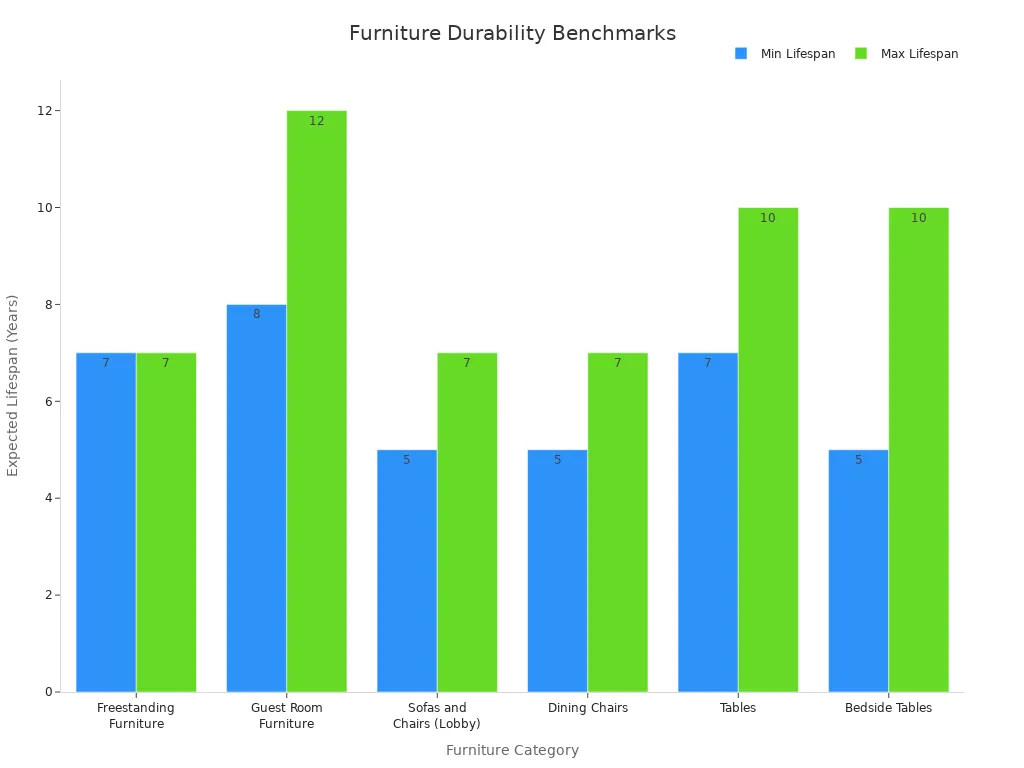
The average lifecycle for hotel furniture assets is typically around seven years. High-quality pieces can extend their service life to 10 years or more with proper selection and maintenance.
Calculating Return on Investment
Calculating the return on investment (ROI) for hotel furniture involves several key metrics. Interactability assesses how people react to the furniture. "Instagram-worthy" designs can lead to social media engagement and increased customer traffic. This translates directly into revenue. Durability focuses on the furniture’s longevity and resilience. Durable furniture, often with warranties, reduces replacement and maintenance costs. This preserves the investment. Functionality considers how well the furniture serves its purpose. It also enhances the customer experience. Examples include adding power outlets to booths or privacy panels. Functional furniture improves customer retention and builds brand loyalty.
Building Strong Relationships with Your Hotel Furniture Supplier

Building strong relationships with your hotel furniture supplier ensures project success and long-term value. These partnerships extend beyond transactions, fostering mutual growth and efficiency.
Fostering Open Communication
Hoteliers must establish clear communication channels with their suppliers. This sets expectations effectively and fosters collaborative relationships. Mutually beneficial partnerships develop through consistent dialogue. Regularly assessing supplier performance helps maintain transparency and collaboration. This approach addresses issues promptly and builds stronger relationships. Active listening helps understand vendor perspectives. Encouraging open feedback facilitates continuous improvement. A culture prioritizing transparent communication prevents misunderstandings and fosters loyalty.
Establishing Performance Review Mechanisms
Implementing robust performance review mechanisms is crucial. These mechanisms allow hotels to regularly assess their suppliers’ effectiveness. Establish clear key performance indicators (KPIs) for quality, delivery times, and responsiveness. Regular reviews provide opportunities to discuss successes and areas for improvement. This structured feedback loop ensures accountability and drives continuous enhancement in service and product quality. Consistent evaluation strengthens the partnership over time.
Addressing Challenges and Resolving Disputes
Challenges inevitably arise in any project. Proactive measures minimize their impact. Thorough vendor vetting, for example, prevents many common issues like delays or quality problems. Hoteliers must balance aesthetics with functionality, choosing commercial-grade construction and high-quality materials. This avoids furniture that breaks easily or causes guest discomfort. Clear, detailed specifications also prevent misinterpretations. When disputes occur, a structured approach is essential. Referencing comprehensive contractual agreements, which outline dispute resolution procedures, guides the process. This ensures fair and efficient outcomes for both parties.
Future-Proofing Your Hotel Furniture Sourcing Strategy
Hotels must proactively adapt their furniture sourcing strategies. This ensures long-term success and resilience in a dynamic market. Future-proofing involves embracing sustainability, technology, and evolving industry standards.
Prioritizing Sustainable and Eco-Friendly Options
Prioritizing sustainable and eco-friendly options is crucial. Sustainable furniture attracts environmentally aware travelers. It helps hotels meet their sustainability goals. Integrating sustainable furniture enhances the guest experience. It offers comfort, aesthetics, and environmental responsibility. This aligns with modern travelers’ values. Adopting sustainable furniture leads to long-term cost savings. Durable materials reduce maintenance needs. It also bolsters brand reputation. Choosing sustainable furniture helps reduce carbon emissions. It minimizes waste and conserves natural resources. This contributes to a smaller ecological footprint. Providing sustainable amenities increases guest satisfaction and fosters loyalty.
Adapting to Technological Advancements
Hotels must adapt to technological advancements in furniture. Modern furniture often includes built-in USB ports and wireless charging stations. Modular furniture designs allow easy reconfiguration. Future advancements include smart materials and adaptive furniture. Beds adjust firmness based on guest preferences. Chairs offer customized ergonomic support. Digital tools also streamline procurement. Specification software centralizes design specifications. Furniture inventory management software tracks assets. Interior design procurement software centralizes activities. Cloud-based collaboration platforms enable global design teams to work seamlessly. AI-powered analytics suggest design choices. Predictive design trends anticipate future guest preferences. IoT-based systems monitor and reduce energy consumption. Smart materials enhance energy efficiency. Digital tracking tools measure a project’s carbon footprint. Virtual Reality (VR) allows clients to experience digital replicas. Augmented Reality (AR) assists FF&E installers.
Staying Informed on Industry Standards
Staying informed on industry standards is essential. Organizations like the National Fire Protection Association (NFPA) mandate rigorous flame retardancy tests. BIFMA standards ensure furniture withstands hospitality use. ASTM and ANSI set benchmarks for fire resistance and structural integrity. The California Bureau of Household Goods and Services (CBHGAS) oversees product certification. International standards vary significantly, especially for fire safety. Fire-resistant materials minimize hazards. Flammability standards and ignition resistance are critical. Bio-based foams offer fire resistance and eco-friendliness. Rigorous testing and certification ensure safety and durability. The Green Seal standard GS-33 restricts paints. ASTM F2057-23 prevents furniture tip-overs. California Proposition 65 addresses material safety. Local building codes dictate furniture arrangement. Furniture materials must be free from toxic chemicals. Stability and tip-over resistance are vital. Structural integrity prevents issues like warping. Mechanical hazards are avoided by design. Greenguard Certification tests for harmful emissions.
Balanced procurement is strategically important for hotel longevity. Effective cost-quality management yields significant benefits. These include increased durability, lower total ownership costs, and enhanced guest satisfaction. Hotels implementing comprehensive quality control programs report 30-40% fewer warranty claims. Enduring partnerships with hotel furniture suppliers are invaluable. They ensure consistent quality and support long-term success.
FAQ
What defines a reliable hotel furniture supplier?
A reliable supplier offers consistent quality, meets deadlines, and provides excellent customer service. They also have a strong track record and transparent manufacturing processes.
Why is a 5-year warranty common for hotel furniture?
A 5-year warranty is standard. It covers defects and ensures durability. This period reflects the expected lifespan of quality hotel furniture under normal use.
How does sustainable furniture benefit a hotel?
Sustainable furniture attracts eco-conscious guests. It reduces environmental impact and can lead to long-term cost savings. This also enhances a hotel’s brand reputation. 🌿